Adult day programs vs. memory care communities: comparing cost and fit
By Diego Cohen · Updated 2026-07-20

For a lot of families, the choice is not between doing nothing and moving a loved one into a memory care community. It is between a handful of options that sit somewhere in between, and adult day programs are usually the first one worth pricing out, since they let someone stay in their own home at night while getting structured, supervised care during the day.
How the day-to-day cost compares
Adult day programs in this region typically run somewhere between $70 and $150 a day, depending on the program and whether transportation or meals are bundled in. A family using a program three days a week is often looking at roughly $200 to $450 a week, well below the cost of a residential memory care placement, which commonly starts in the $5,000 to $9,000 a month range before care level fees.
The catch is that a day program only covers, well, the day. If your loved one needs supervision overnight, on weekends, or on the days they are not enrolled, you are either providing that care yourself or paying for it separately, often through in-home aides billed by the hour. Once you add up a day program plus evening and weekend coverage, the gap between that combination and full residential memory care narrows considerably.
Table: what each option actually includes
| Adult day program | In-home aide (add-on) | Residential memory care | |
|---|---|---|---|
| Typical cost | ~$70-$150/day | ~$28-$40/hour depending on caregiver level | ~$5,000-$9,000+/month |
| Coverage | Daytime, weekdays usually | Hours you schedule | 24/7 |
| Supervision at night | None | Only if scheduled | Included |
| Social activities | Structured, group-based | Depends on the aide | Structured, group-based |
| Best fit | Early to moderate stage, caregiver still primary support | Filling specific gaps | Moderate to advanced stage, or caregiver can no longer manage alone |
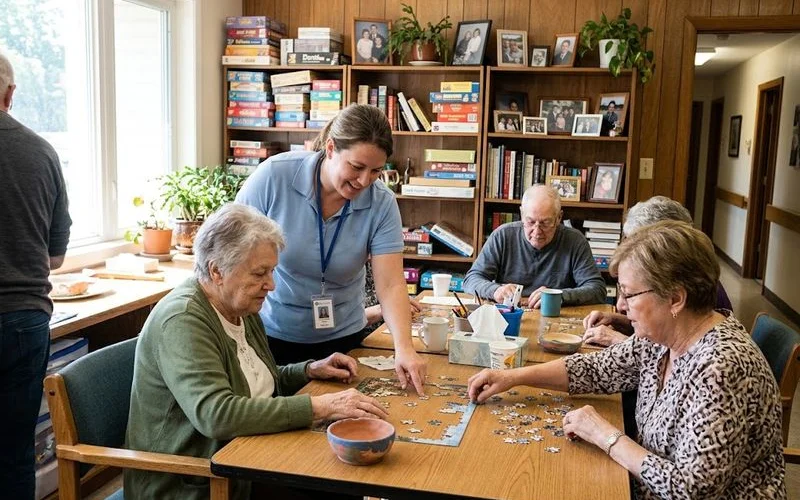
When a day program is the right call
A day program tends to work well when the person with dementia is still safe overnight, when a family caregiver is working or simply needs consistent daytime relief, and when the person can tolerate a group setting without significant agitation. It is also a reasonable way to test the waters: some families use a day program to see how their loved one responds to structured group activities before committing to a bigger transition. Once you have settled on a day program as the right next step, choosing an adult day program for dementia walks through the questions worth asking before you enroll.
When it stops being enough
The math and the fit both change once nighttime becomes unsafe, whether that is wandering after dark, falls, or a caregiver who is no longer physically able to manage overnight care. At that point, stacking a day program on top of in-home evening care can end up costing close to what residential memory care runs, without the built-in security and staffing a dedicated community provides. That is usually the signal to start touring residential options seriously, even if the final decision takes a few more months.
What families often get wrong on the first pass
The most common mistake is comparing a day program’s daily rate directly against a residential community’s monthly rate without accounting for what each one actually replaces. A day program’s price only covers hours your loved one is enrolled; it does not include groceries, utilities, transportation to appointments, or the value of the time a family caregiver still spends on mornings, evenings, and everything a facility would otherwise handle. Once you add those costs back in, a day program is still usually cheaper, but the gap is narrower than the headline numbers suggest. It helps to write out a full weekly budget under each scenario rather than comparing a single daily or monthly figure in isolation.
Making the comparison concrete
Before deciding, price out your actual week: how many days of day-program coverage you need, how many hours of additional in-home help fill the remaining gaps, and what that adds up to monthly against a residential quote. Our methodology explains how we score both adult day programs and residential communities on staffing and family-reported experience, which is useful once you’re ready to compare specific providers rather than just categories. You can browse every option we track from the home page.
This is general information, not financial advice. Actual rates vary by provider and by the specific care plan, so confirm current pricing directly before budgeting around these ranges.
Frequently asked questions
- Is an adult day program always cheaper than memory care?
- Per week, usually yes, since you're paying for daytime hours rather than round-the-clock housing, meals, and staffing. But once someone needs supervision overnight or on weekends too, the math shifts, since you'd be paying for a day program plus additional care for the rest of the week.
- Can adult day programs handle someone with moderate or advanced dementia?
- It depends on the specific program. Some specialize in memory care and are staffed and secured for wandering risk and behavioral symptoms; others are general senior day programs that may not be equipped for more advanced dementia. Ask directly about staff training and how they handle agitation before enrolling.
- What happens if my loved one's needs outgrow a day program?
- This is common as dementia progresses. Families often start with a day program a few days a week, then add more days, then in-home care for evenings, and eventually move to a residential memory care community once daytime and nighttime supervision both become necessary.
- Does insurance cover adult day programs?
- Rarely as a standalone benefit. Some long-term care insurance policies include adult day services, and certain Medicaid waiver programs can help cover it, so it's worth checking an existing policy or asking a caseworker rather than assuming it's out of pocket entirely.