Skilled nursing with memory care vs. memory care assisted living: what's the difference
By Diego Cohen · Updated 2026-08-03
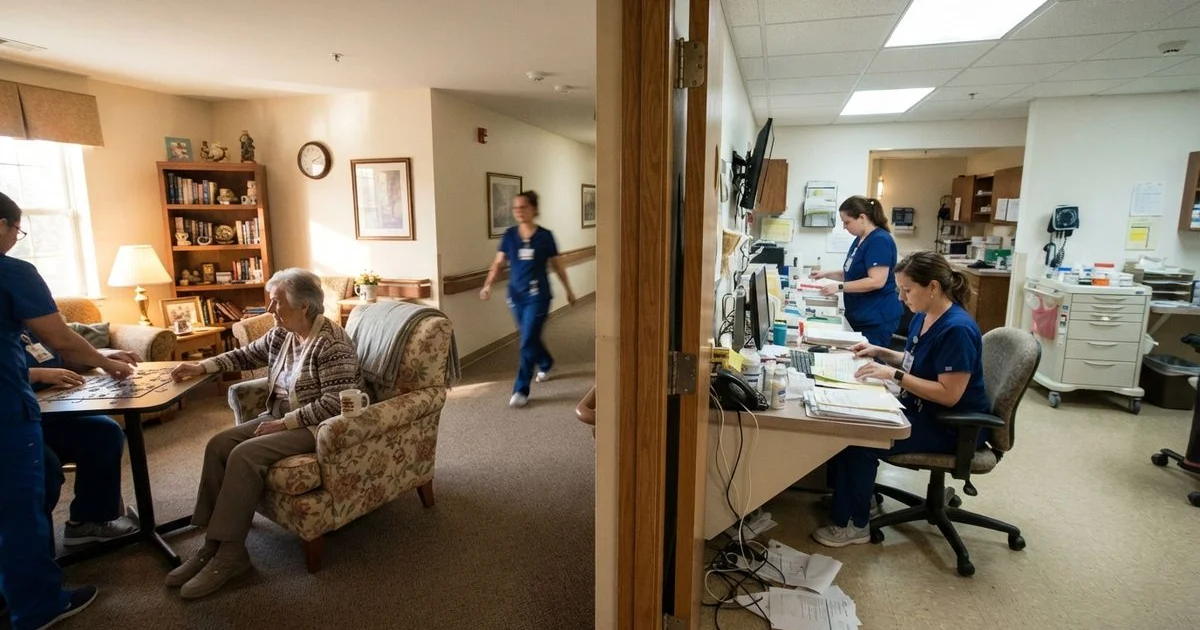
Families researching memory care often assume it’s a single category, then get confused when they run into two different terms: memory care assisted living and skilled nursing with memory care. Both provide secured, dementia-trained care. The difference is what happens when medical needs go beyond supervision and daily assistance.
What memory care assisted living actually covers
Memory care assisted living combines standard assisted living, help with bathing, dressing, medication management, and meals, with features specific to dementia: secured entrances so residents can’t wander off, layouts designed to reduce confusion, and staff trained in redirection and behavior management. It’s built for residents whose primary need is structure and supervision rather than ongoing medical treatment.
What skilled nursing with memory care adds
Skilled nursing with memory care layers licensed nursing care on top of that same dementia-specific foundation. That means registered nurses and certified nursing assistants on-site around the clock, equipped to handle wound care, IV therapy, feeding tubes, post-hospital rehabilitation, and medication regimens that require closer medical oversight than assisted living staff are trained or licensed to provide. It’s the setting families usually land in after a hospital stay, a diagnosis that has progressed into a more medically complex stage, or when a resident’s health has become too complicated for an assisted living team to manage safely.
Table: side by side
| Memory care assisted living | Skilled nursing with memory care | |
|---|---|---|
| Staffing | Trained aides, some nursing oversight | Round-the-clock licensed nurses and CNAs |
| Medical care | Medication management, basic health monitoring | Wound care, IV therapy, complex medication regimens |
| Typical monthly cost | Roughly $5,000-$9,000 before add-ons | Roughly $9,000-$13,000 |
| Typical resident | Needs supervision and daily living assistance | Needs both dementia care and ongoing medical treatment |
| Common path in | Direct move from home | Often follows a hospital stay or health decline |
Signs it’s time to consider skilled nursing instead
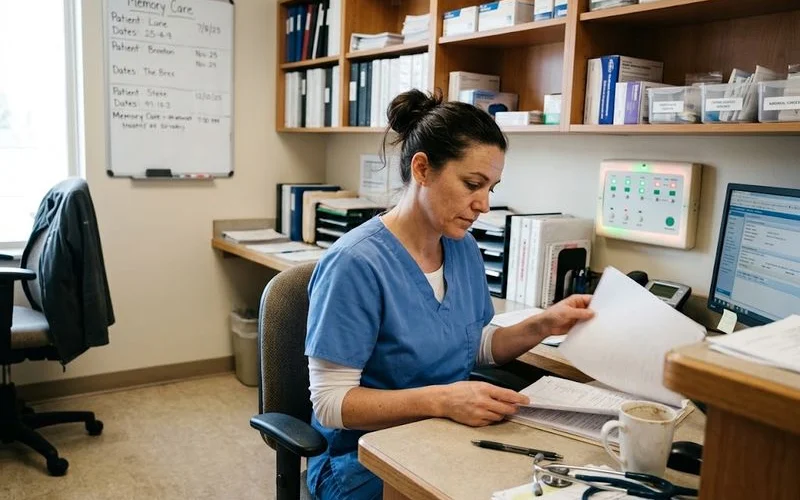
A few situations tend to push families from assisted living memory care toward skilled nursing: frequent falls that require medical follow-up, a feeding tube or complex wound care need, a condition requiring daily nursing oversight rather than periodic check-ins, or a hospital discharge where the physician recommends a higher level of medical support than assisted living can provide. A discharge planner or the resident’s physician is usually the most reliable source for this determination, since they can weigh the actual medical picture rather than a general sense of decline.
What to ask when comparing specific facilities
Beyond the general category, ask each facility about their specific memory care unit: is it a separate secured wing within the larger skilled nursing floor, or fully integrated? How often does a physician or nurse practitioner round on the unit? What’s the staff-to-resident ratio on the memory care wing specifically, separate from the general nursing floors? These details vary more between individual facilities than the broad category label suggests.
Why some facilities offer both under one roof
A number of senior living campuses in this region hold licenses for both levels of care, which lets a resident move from assisted living memory care into skilled nursing without changing addresses if needs increase. This matters more than it might seem: an in-place transition means familiar staff, a resident who doesn’t have to relearn a new environment during an already difficult health change, and a shorter adjustment period for everyone involved. If avoiding a second move down the line is a priority, ask directly during your initial tour whether a community offers this kind of continuum, and how the transition between levels typically works if the need arises.
Making the decision
If you’re unsure which setting fits, start with a conversation with your loved one’s physician or a hospital discharge planner, who can assess the actual medical need rather than relying on cost or convenience alone. For a full breakdown of what drives the monthly rate at either level, see what memory care costs in Connecticut. Our methodology explains how we evaluate both types of providers, and you can compare specific options across the region from the home page.
This is general information, not medical advice. A physician or discharge planner can assess which level of care fits your loved one’s specific medical needs.
Frequently asked questions
- How do I know which level of care my loved one actually needs?
- A hospital discharge planner, a geriatrician, or the admissions team at a facility can help assess this, but generally: if the main need is supervision, structure, and help with daily tasks, memory care assisted living usually fits. If there are complex medical needs like wound care, a feeding tube, or frequent falls requiring medical intervention, skilled nursing is more likely necessary.
- Can someone move from one setting to the other later?
- Yes, and it happens often. A resident might start in assisted living memory care and transition to skilled nursing if medical needs increase, or move from a short-term skilled nursing rehab stay into longer-term memory care if returning home isn't realistic.
- Does skilled nursing always cost more?
- Generally yes, since it includes round-the-clock licensed nursing staff on top of dementia-specific programming. Assisted living memory care can still be a significant cost, but it typically runs lower than a comparable skilled nursing placement.
- Is the memory care itself different between the two settings?
- The core elements, secured living areas, staff trained in dementia behaviors, and structured activities, appear in both. The difference is what surrounds that care: skilled nursing adds licensed medical staff and equipment for more complex health needs that assisted living isn't set up to handle.