Memory care licensing in Connecticut: what the different labels actually mean
By Diego Cohen · Updated 2026-08-06
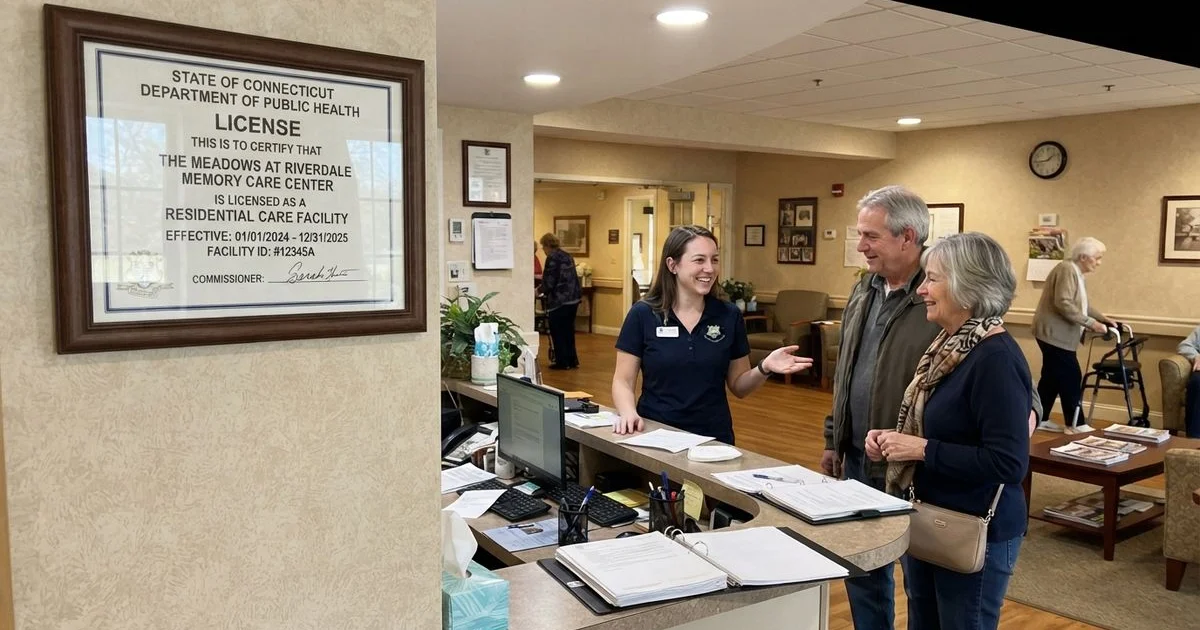
Connecticut regulates memory care through a handful of overlapping license types, and the terminology on a facility’s website doesn’t always make clear which one applies. Understanding the basic categories helps you ask sharper questions and avoid assuming a facility offers more medical care than its license actually permits.
The main license types you’ll run into
A residential care home (RCH) houses residents who need personal care and supervision but not skilled nursing. Staff help with daily living tasks, but a resident’s own physician manages medical treatment, since RCHs don’t provide nursing care directly.
A Managed Residential Community (MRC) license permits a facility to combine housing with assistance services and medication management, sitting in a regulatory tier between independent housing and a nursing home.
A chronic and convalescent nursing home (CCNH) is a fully licensed skilled nursing facility, with registered nurses and CNAs providing round-the-clock medical care, wound care, and rehabilitation. Many CCNHs operate a dedicated memory care unit within the larger facility.
Separately, an Assisted Living Services Agency (ALSA) is its own licensed entity that actually delivers the hands-on personal care within a residence. The building’s housing license and the ALSA’s services license are distinct, and you’ll often deal with both when you move in, even if the same parent company runs each.
Table: quick comparison
| License type | What it covers | Medical staffing | Typical use |
|---|---|---|---|
| Residential Care Home (RCH) | Housing, supervision, personal care | No on-site nursing care | Lower-acuity assisted living and memory care |
| Managed Residential Community (MRC) | Housing plus assistance and medication management | Limited, coordinated support | Mid-tier assisted living |
| Chronic and Convalescent Nursing Home (CCNH) | Full skilled nursing and rehabilitation | Round-the-clock licensed nurses | Skilled nursing with memory care |
| Assisted Living Services Agency (ALSA) | Personal care services within a residence | Trained care staff, not nursing | Operates alongside a housing license |
Why this matters when you’re comparing communities
A facility’s license type is a more reliable signal than its marketing copy about what level of medical support is actually available. If your loved one has complex health needs, confirming a facility holds a CCNH license, not just an RCH or MRC, tells you they’re equipped for that. If the main need is supervision and daily assistance, an RCH or MRC-licensed community may be entirely appropriate and typically costs less. Licensing determines what a facility must offer; what Connecticut law protects once someone has moved in is a separate question worth understanding too.

The disclosure document worth asking for
Connecticut requires facilities offering specialized dementia care to provide a written Alzheimer’s special care unit disclosure before admission. This document covers staff training and credentials, the therapeutic programming used for memory loss, and physical design features like secured outdoor space and wayfinding systems. If a facility hasn’t handed you this during the tour process, ask for it directly. It’s one of the more concrete, standardized documents you’ll get in an otherwise brochure-heavy process.
How this connects to the ALSA that provides your care
It is easy to focus entirely on the housing license and overlook the Assisted Living Services Agency that actually delivers hands-on care day to day. Because the ALSA holds its own separate license and its own staffing and training standards, two communities sharing the same housing license type can still differ meaningfully in the quality of the care team, depending on which ALSA they contract with. Ask specifically who employs the aides who will be working with your loved one, whether that’s the community itself or a contracted ALSA, and how long that relationship has been in place. A facility that has worked with the same ALSA for years tends to have more consistency than one that has switched providers recently.
Verifying what you’re told
You can confirm a facility’s current license status and check for recent inspection findings through Connecticut’s Department of Public Health, Facility Licensing and Investigations Section. It’s a worthwhile step if a facility’s answers about their license type or medical capabilities felt vague during a tour. Our methodology explains how we factor licensing and safety design into provider scores, and you can browse every community we track from the home page.
This is general information, not legal advice. Contact Connecticut’s Department of Public Health or an elder law attorney for guidance specific to a facility or situation.
Frequently asked questions
- Why does a facility's license type matter to my family?
- The license determines what level of medical care staff are legally authorized to provide. A residential care home can't offer the same skilled nursing services a chronic and convalescent nursing home does, so knowing the license type tells you what's actually possible there, regardless of what the marketing brochure implies.
- How do I find out what license a specific community holds?
- Connecticut's Department of Public Health, Facility Licensing and Investigations Section maintains licensing records and can confirm a facility's current status. It's a reasonable step before or after a tour, especially if a facility's marketing language is vague about what type of care they're licensed for.
- Can one building hold more than one type of license?
- Yes. Many senior living campuses in this region operate under multiple licenses at once, for example a residential care home for assisted living alongside a chronic and convalescent nursing home license for a separate skilled nursing wing, so residents can transition between levels of care without changing addresses.
- Does a facility have to disclose its dementia care approach specifically?
- Yes. Connecticut requires facilities offering specialized dementia care to provide a written Alzheimer's special care unit disclosure describing staffing, training, and programming for that unit. Ask for this document directly if a facility doesn't offer it upfront.